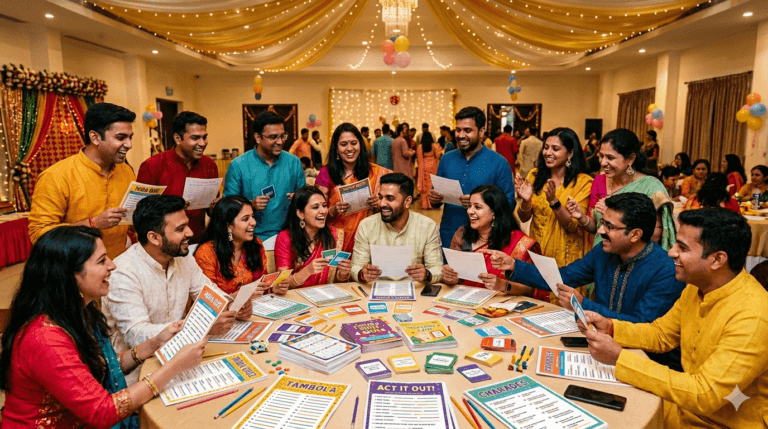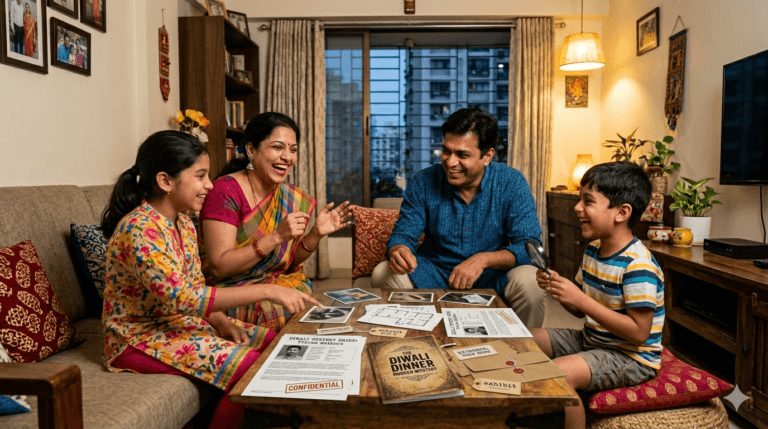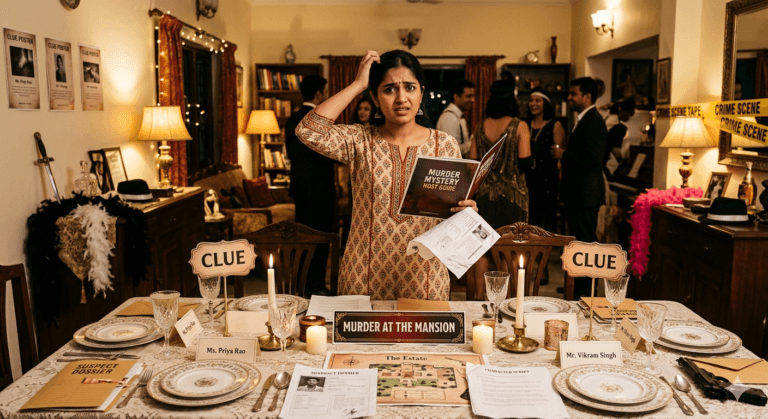
Here’s how every Indian house party goes.
7:30 PM — First guests arrive. Hugs, pleasantries, “traffic tha yaar.”
8:00 PM — Everyone’s here. Snacks are out. Someone opens a drink. Conversations start in clusters — the guys in one corner, the couples in another, the one person who showed up not knowing anyone hovering near the food.
8:30 PM — “So… what should we do?” Someone suggests cards. Two people are into it. Four aren’t. The suggestion dies. Someone else says antakshari. Half the room groans. Dumb charades is proposed as a compromise. Three rounds later, it’s already losing steam.
9:30 PM — Food arrives. Everyone eats. Conversations resume. Phones come out. The energy drops.
10:30 PM — “Okay yaar, we should do this more often.” Everyone leaves. The host cleans up and thinks, “That was fine. But it wasn’t great.”
Sound familiar? It should. Because this is the default Indian house party experience, and it’s been the same for decades.
Why this keeps happening
It’s not because Indian friend groups are boring. It’s because the “activity toolkit” hasn’t evolved. Cards, charades, antakshari, maybe Ludo or a board game if someone brings one — that’s the entire playbook. And the problem with all of these is that they’re either:
- Only fun for the people who are good at them (cards, trivia)
- Embarrassing for introverts (charades, antakshari)
- Not engaging enough to hold a room (Ludo, board games at a party)
The result: the host never finds a game that works for the ENTIRE group. So they default to “let’s just hang out” — which is fine but forgettable.
What actually works
The best house party activities share three traits: everyone participates, nobody needs special skills, and the experience creates stories people retell afterward.
Here are five ways to break the cycle:
1. Give everyone a role to play
This is why murder mystery games work so well. Instead of asking people to “be themselves but more fun” (which is what every other party game implicitly demands), you give them a character. A persona. A set of secrets and a mission.
Suddenly the quiet friend has a script to lean on. The shy person has a reason to approach strangers. The loud person has a target for their energy. Nobody’s sitting out because everyone has something to DO.
2. Create a shared mystery, not a competition
Most party games are competitive — one team wins, one loses. This creates an energy divide: the winners are happy, the losers feel meh. A murder mystery is collaborative (everyone’s solving the same puzzle) and individual (everyone has their own secrets and goals). There’s no “losing team” — just different theories and dramatic reveals.
3. Use your actual culture
The reason imported party games feel flat is because the cultural context doesn’t land. A murder mystery set at a British manor is someone else’s drama. A murder mystery set at a Punjabi wedding IS your drama — the family politics, the passive-aggressive aunty, the cousin who showed up uninvited, the uncle who definitely knows more than he’s saying.
When the setting feels real, the roleplaying feels real. And when the roleplaying feels real, the fun multiplies.
4. Feed people while they play
This is the Indian party hack that Western game companies never think about. In India, food IS the party. Any activity that separates “game time” from “food time” is fighting a losing battle.
The best party activities run alongside dinner — finger food, buffet style, eat while you investigate. Murder mystery games are designed for exactly this. Guests eat, drink, and solve a murder simultaneously.
5. Plan for the phone problem
The real enemy of every modern house party is the smartphone. If your activity isn’t more engaging than Instagram, you’ve lost.
The test is simple: are guests so involved that they forget to check their phones? If yes, you’ve won. Murder mysteries, properly run, consistently pass this test — because every conversation matters, every person is a potential suspect, and you can’t scroll through Reels while someone is accusing you of fictional homicide.
The bottom line
Indian house parties don’t need more food or louder music. They need better activities — ones that include everyone, feel culturally relevant, and create the kind of moments people bring up in the group chat for weeks afterward.
If you want to try hosting a murder mystery night, check out our game packs at murdermysterypartypacks.com — designed for Indian friend groups, printable in 30 seconds, and tested to keep phones in pockets for 3 hours straight.